
It’s been eleven years since my last blog post. My novels have taken precedence over what was originally an academic pursuit.
As part of my Design Fiction thesis, my previous blog—under the same name—was my foray into weekly evidence that, as design and technology were marching onward, we were not paying attention. Enamored as we are with what we create, we can behave like children, glassy-eyed over the flashing lights, without ever asking if it was good—something the original Creator asked of his work at the end of each day.
When I stopped writing the blog, back in 2017, I illustrated weekly examples of how we were blazing forward without scrutiny. Now, many years later, nothing has changed, except for the fact that our design and technology are a thousand times more powerful and the edge between amazement and disaster is much thinner. A nanothread, perhaps.
It’s not hard to find examples today. It is actually more difficult to ignore them than ever before. I’ll begin today with this morning’s news from 36kr Europe (eu.36kr.com), a site that, according to its blurb, “delivers global business and markets news, data, analysis, and video to the world, dedicated to building value and providing business service for companies’ global expansion.”
The headline reads:
“A single image scared a researcher into resigning on the spot, and the craziest viral image from Anthropic has leaked out.”
The story goes on to recount how an AI Researcher at Anthropic was so shocked by a graph depicting exponential computing power that he resigned, giving up stock options and possibly tanking his career. There’s a lot of jargon in the article that probably makes perfect sense to researchers, but there are some really important takeaways.
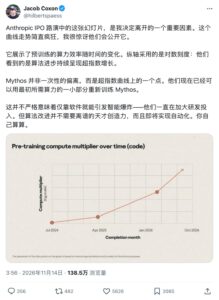
The article states:
“Surprisingly, Anthropic even took this internal legendary chart as its top trump card and made it public during the IPO roadshow. It publicly released this internal top-secret chart as its core highlight.”
It would appear as though they are pretty happy with themselves.
The next passage is especially alarming:
“The orange curve on the chart is so steep that it cannot be contained even by the logarithmic coordinate, and it is still accelerating upward sharply. From the perspective of insiders, this is no different from sounding the ‘Singularity Alert.'”
“From the perspective of front-line researchers, this is no different from personally turning on the valve of ‘AI accelerates its own creation.'”
As I said, it’s not difficult to find examples of the unforeseen consequences of our obsessions, to be the first to issue that killer IPO, or just pat ourselves on the back.
What do we do about this? Some would say more government oversight, or laws to prohibit this or that. But ultimately, the check is ourselves. We are the consumers of all of this frenzy. We are sponges for the latest and greatest.
I wrote this back in 2017:
“The Human Sponge
Futurist and tech writer Andy Walker says (Mac, 2016) ‘[…] anything
that’s new seems like a threat […],’ but these confrontations are
mitigated because ‘[…] technology comes along in increments.’
Kurzweil (2005) concurs: ‘We are not going to reach the Singularity
in some single great leap forward, but rather through a great
many small steps, each seemingly benign and modest in scope.’
History has shown that these steps are incrementally embraced by
society and often become grand in scale. Such scalable events can
become complex systems with a life of their own. The automobile
is efficient as a means to get from point A to point B, but we see
a much higher level of complexity in the systems that sustain our
travels: infrastructure, roads, traffic management, fueling, maintenance,
safety, etc. We see similar systems resulting from air travel,
the Internet, and the smartphone. Each of these technological
developments has initiated a chain-reaction of supportive rules,
dangers, legalities, even behavioral disorders that are difficult to
grasp. And while there is traditionally some initial reticence to these
technologies at their introduction, the public has ultimately adopted
them and asked for more, often in advance of a serious review of
the ramifications of ethics, policy, and human behavior.”
Here we go again.